Best Prop Firm Passing Service in 2026: How to Compare Providers Without Getting Burned
Almost every page titled "best prop firm passing service" is an affiliate list. The ranking is decided by what the author earns per referral, not by whether the arrangement survives contact with the firm's own terms. This page is built the other way around. It starts with the clause that can void a pass, prices every route to a funded account honestly, and hands you a vetting method you can apply to any provider — including the one that funds this site.
Disclosure
This site is supported by ElitePropX, which sells a flat-fee challenge-passing service. That is disclosed on the About page, and it is the reason this page exists — and also the reason the compliance section below is longer than the sales section. A guide to this product that only listed benefits would be useless to you, and useless as a page. Nothing here is a ranking of providers by performance, because no third party can measure that from outside.
What "best" has to mean here
The word "best" does no work on its own. Best at what, for whom, measured how? A provider that passes a $100,000 evaluation in nine days is best for someone who needs speed and has written permission to use it. The same provider is worthless to a trader at a firm that voids accounts traded by a third party, no matter how good its execution is.
So this page scores providers on six criteria, and only one of them is about trading skill. Everything else is about whether the arrangement is safe and honest enough to be worth considering at all.
| # | Criterion | The question it answers | Why it dominates the ranking |
|---|---|---|---|
| 1 | Compliance fit | Does your firm permit third-party trading, in writing? | If not, every other criterion is irrelevant. The pass is void. |
| 2 | Rule coverage | Does the provider trade inside drawdown, consistency, news and weekend rules? | A pass that breaches a secondary rule is not a pass. See challenge rules versus funded rules for how much tighter this gets after funding. |
| 3 | Failure terms | What happens, in writing, when an account is breached? | This is where undefined providers turn a service into a dispute. |
| 4 | Cost per funded account | Total spend before the first payout, including retries. | Not the sticker fee. The all-in cost. |
| 5 | Durability | Does the arrangement leave you able to pass the next challenge unaided? | A funded account you cannot keep is not an asset. |
| 6 | Transparency | Named entity, written scope, stated rule coverage, no guarantees. | Everything above is only verifiable if the provider will put it in writing. |
Notice what is missing from that list: win rate, number of clients, testimonials, and speed as a standalone virtue. Speed matters only after criteria one to three are satisfied. A provider advertising a 24-hour pass is advertising that it moved fast, not that the result stands. If you want the wider context on why this product exists and who it is for, the companion piece on whether a passing service is legit covers the ethics; this page covers the comparison.
The clause that decides everything
There are two separate concepts in prop firm terms, and traders collapse them into one at their peril:
- Automation. Software placing orders on your own account. Many firms allow this with conditions.
- Third-party trading. Another person accessing and trading your account. This is a different clause, usually in a different section, and it is much more often prohibited outright.
A provider quoting you the firm's "EAs are allowed" policy as permission is answering the wrong question. The EA and copy trading rules page sets out how differently those two clauses are enforced. The short version: automation is usually tolerated, and account sharing usually is not.
Below is the shape of the restriction at the firms most people compare. Treat this as a prompt to go and read the actual clause in your own dashboard — not as a legal summary, and not as advice. Firms change these terms without notice, and the wording differs by product and by account type.
| Firm | What the clause typically restricts | The practical consequence for a bought pass |
|---|---|---|
| FTMO | Access to the account is tied to the account holder; third-party and shared access is restricted, while automated trading is permitted with conditions. | A done-for-you pass sits on the wrong side of that line. See the FTMO rules explained page for where the automation permission ends. |
| FundedNext | Account sharing and third-party trading are restricted; consistency conditions apply on top, at both evaluation and payout stages. | The consistency requirement is a second filter: a pass can be earned but still not be payout-eligible. Covered in FundedNext rules. |
| Apex Trader Funding | Access is restricted to the named trader, with a separate prohibited-strategy list covering latency and high-frequency techniques. | Even a compliant human pass is judged against the strategy list at payout. See Apex rules. |
| Topstep | One trader per account; sharing is not permitted, and the loss limit trails to the starting balance. | There is no cushion beneath a funded account at this firm, so the first weeks after handover are the dangerous ones. See Topstep rules. |
| FundingPips | Restrictions differ by product rather than by firm, including on consistency and shared access. | You cannot read one policy and apply it across products. See FundingPips rules. |
The pattern across all five is the same. Automation is a technical question the firm can answer in a sentence. Third-party trading is a trust question, and firms answer trust questions by prohibiting rather than permitting. That is why "does your firm allow it" must be settled before price is even discussed.
When the clause prohibits it, the consequences are not minor and they do not arrive immediately:
- The evaluation can be voided even if it would have passed on merit.
- Payouts can be withheld, including profits earned after funding.
- The account is usually closed and the relationship ends.
- Detection tends to happen late, at the payout review rather than during the evaluation.
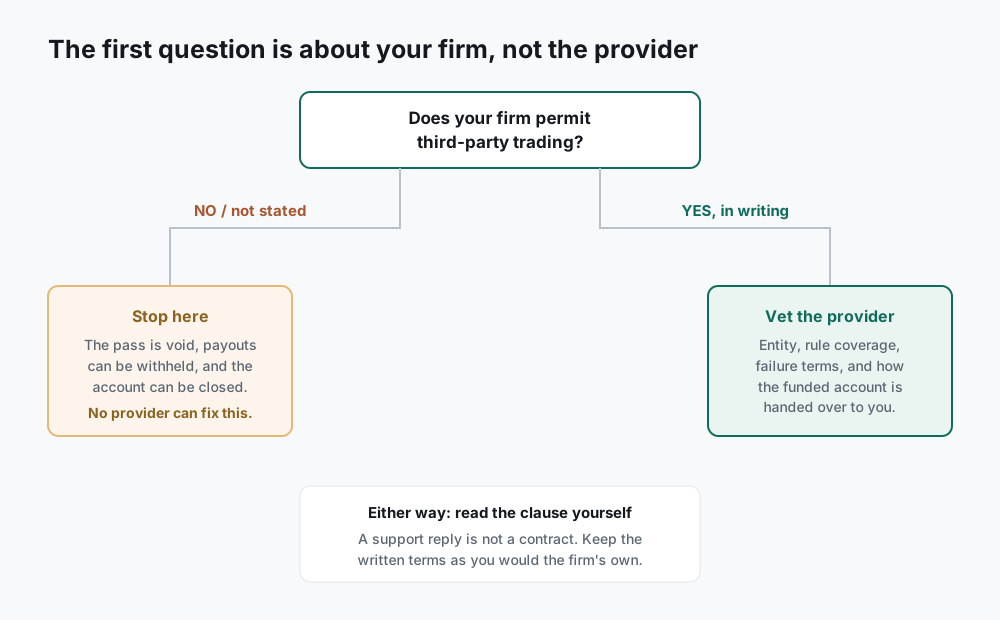
Get the answer in writing, from the firm, not from the provider
A provider that tells you its own arrangement is fine is not a source. Ask your firm's support in writing, keep the reply, and compare it against the clause in the terms. Where the two disagree, the terms win — and if the reply is vague, treat that as a no.
Four products sold under one name
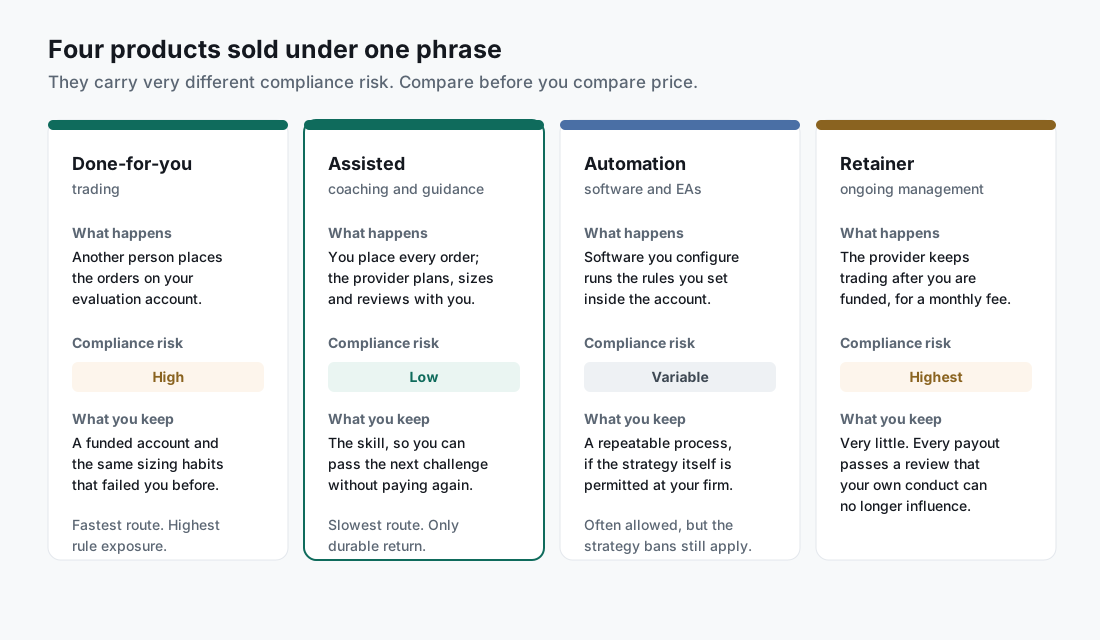
The phrase "passing service" hides at least four different businesses. They carry very different risk profiles, and a page that ranks them together without saying so is misleading by omission.
| Model | Who places orders | Compliance exposure | What you keep at the end |
|---|---|---|---|
| Done-for-you trading | The provider, on your account | High — squarely inside the third-party clause | A funded account, and the same position-sizing habits that failed your own attempts |
| Assisted challenge | You, guided and sized by the provider | Low — the trader is the account holder throughout | The skill, and therefore the ability to pass the next evaluation without paying again |
| Automation and EAs | Software you configure | Variable — allowed, but the strategy bans still apply | A repeatable process, if the strategy itself is permitted |
| Account management retainer | The provider, indefinitely, on the funded account | Highest — ongoing exposure to every rule, including after funding | Very little. Every payout passes a review you can no longer influence |
Two of these four models are honest products with different trade-offs. One is a tool. One — the retainer — is the model where the buyer's incentives drift furthest from the provider's. A done-for-you pass transfers risk once. A retainer transfers it every month, and the longer it runs the more the account's history is written by someone who is not you.
If your firm prohibits third-party trading, the assisted model is not the "lesser" option. It is the only permissible version of the product, and it happens to be the one with a return that compounds.
What a passing service genuinely fixes
Being fair to the product matters, because the honest case for it is narrow but real. There are genuine constraints a service addresses that no amount of discipline resolves:
- Time. Some traders have capital and clear rules but not the hours. A challenge has a minimum trading-day floor and a deadline; a service compresses the calendar without breaking either. The realistic timelines page shows how much of a challenge is a waiting problem rather than a skill problem.
- Capital for repeated attempts. If a challenge fee times four is genuinely out of reach, a single fixed price converts a variable, unbounded cost into a known one. That is a financing problem and a service can solve it.
- Market access. A trader whose circumstances make a particular session or instrument impractical may still want a funded account in it.
- Execution consistency. A person who understands the rules but cannot resist overriding a stop can, in principle, buy their way past their own worst habit for one evaluation.
Notice that the last one is also the most dangerous reason on the list, because it is the only one where the underlying problem travels with the account. The others are constraints the service removes. That one is a habit the service hides — for exactly as long as the funded account takes to reopen it.
What it cannot fix
A passing service buys an account. It does not buy the ability to keep one. Funded accounts carry the same drawdown rules as the evaluation, and often stricter payout conditions on top of them. That produces a very specific failure sequence that anyone selling the product should describe and most do not:
- The evaluation is passed by someone with better execution than the buyer.
- The funded account is handed over.
- The buyer trades it with the same sizing that failed their own attempts.
- The account is breached, usually inside the first few weeks.
- The fee is gone, the funded account is gone, and the original problem is untouched.
This is not a rare edge case. It is the modal outcome when the reason for buying was risk discipline rather than time or capital. The five failure modes behind most failed evaluations are behaviour, not information — and behaviour is the one thing a purchase does not transfer.
There is a second thing the product cannot fix, and it is structural. The firm's rules bind the account, not the account holder's intentions. A rule about who may place orders is breached by the act of placing them, whether or not the account was profitable at the time. In that sense a bought pass is a conditional pass even when the dashboard says otherwise. The condition is compliance, and it is evaluated at the worst possible moment.
The arithmetic of cost per funded account
Comparisons collapse because two providers quote different things and neither quotes the number that matters. The number that matters is this:
Cost per funded account = (fee × expected attempts) + service fee + retainer fees + the value of the time you spent chasing it.
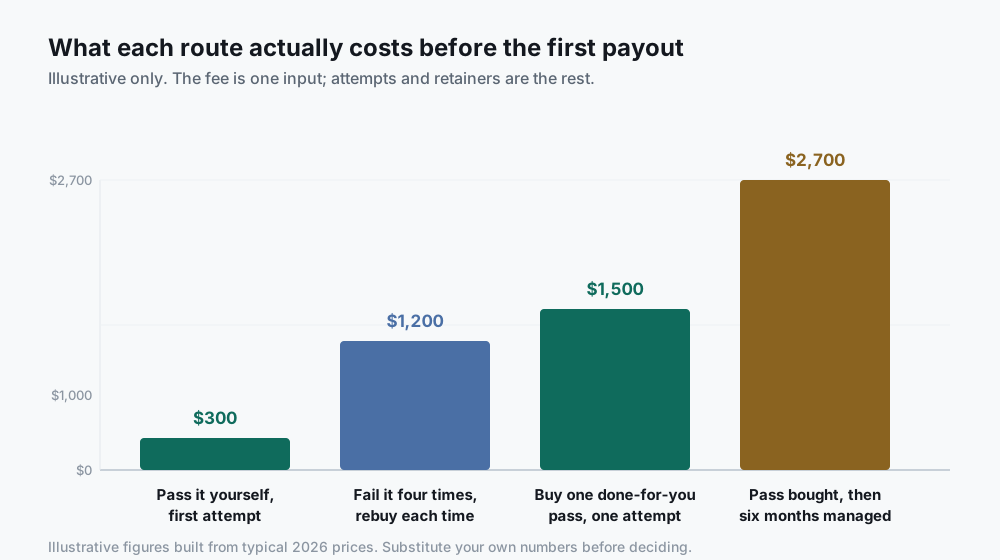
Nothing about that formula favours buying or doing it yourself. It only forces the comparison onto the same terms. Worked through with illustrative numbers:
| Route | Illustrative cost | What has to be true for it to be rational |
|---|---|---|
| Pass it yourself, first attempt | One challenge fee — around $300 at a $100k tier | You can pass, and you can then keep the funded account alive |
| Pass it yourself, four attempts | Around $1,200, spread over months | Nothing. This is the default outcome for an unprepared trader, and it is still cheaper than most services |
| Buy one done-for-you pass | Around $1,500 including the challenge fee | The firm permits it, the provider trades inside every rule, and you can trade the funded account without the same mistakes |
| Buy a pass, then pay a monthly retainer | Around $2,700 over six months | Almost nothing justifies this at a firm that prohibits third-party trading, and the exposure grows monthly |
Two conclusions follow from that table, and they are uncomfortable for both sides of the argument:
- Buying is not automatically the expensive option. Against four failed attempts, a single fixed fee can be cheaper. That is a legitimate selling point, and it is the honest core of the product's case.
- The retainer is where the arithmetic breaks. Once a monthly fee sits on top of a funded account, the total cost climbs past every other route while the buyer's ownership of the outcome shrinks. If a provider's pitch is "we keep trading it for you", the formula above should end the conversation.
One more input belongs in the formula and usually is not: the funded account's expected lifetime. A pass that produces a funded account which survives three months and pays once is worth less than a pass that produces an account the trader can run for a year. The profit split and scaling mechanics determine how much of that lifetime value actually reaches you. Fill in your own numbers before you compare anyone's price list.
A 12-point vetting checklist
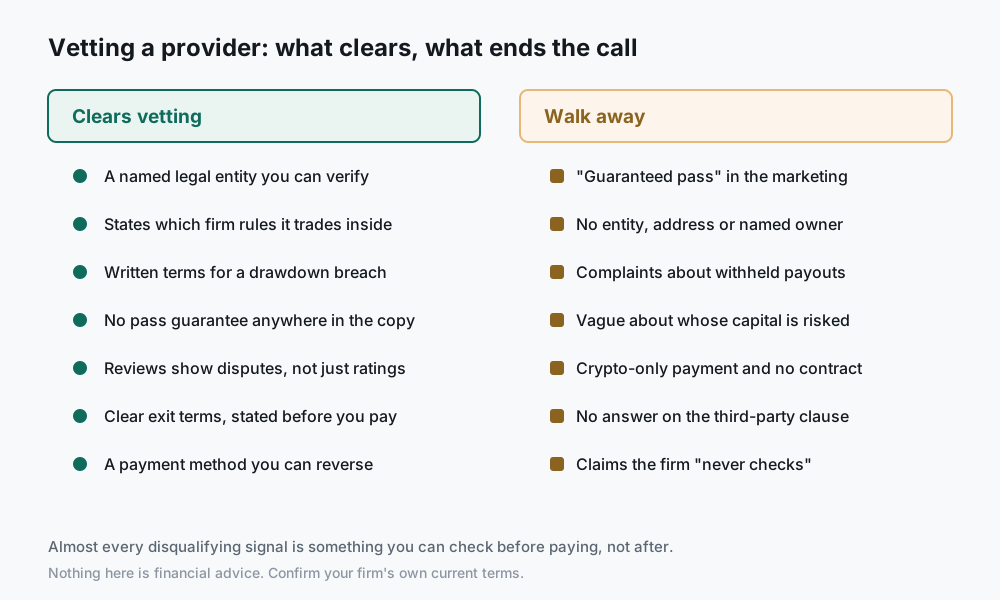
These are in order. Stop at the first one that fails, because the ones after it cannot rescue a failure here.
- Confirm your firm permits it, in writing. Not the provider's assurance — your firm's. This is the only step that can void the purchase, so it goes first. Check it against your rules checklist.
- Find the legal entity. A company name, a registration number and a jurisdiction you can verify in the relevant registry. A provider with no verifiable entity is not a counterparty you can dispute with.
- Ask which firm rules it trades inside. Drawdown calculation, consistency requirement, news restrictions, weekend holding, minimum trading days. If the answer is "we handle all that", the provider does not know what it is trading into.
- Ask what happens on a drawdown breach. A refund, a retry, a partial credit, or nothing. Undefined is not neutral — undefined means nothing, and it means it in a dispute.
- Get the scope in writing. What exactly is being traded, on what account size, with what risk per position, over what period, and who bears the challenge fee.
- Read reviews for disputes, not scores. Search "payout withheld", "refund refused", "blown account". Specific and repeated complaints from identifiable accounts are the signal; a five-star average is not. How to read reviews at all is covered in reading prop firm reviews.
- Check for guarantee language. A guarantee of a pass means the provider either misunderstands the market or intends not to honour it. Both are disqualifying, for different reasons.
- Ask how the funded account is handed over. Credentials, platform, and whether the provider retains any access afterwards. Any retained access is an ongoing breach exposure.
- Test the exit terms. What it costs, and how long it takes, to walk away. A provider that requires ongoing access as a condition of the pass has priced your exit at nothing.
- Check the payment method. A reverseable, documented method is a feature. Crypto-only with no contract is a red flag that also removes your remedies.
- Ask whether they trade your account or coach you. If both are offered, price them separately and think hard before choosing the one that touches the account.
- Re-read your firm's terms one final time. Not the reply from support; the clause itself. If it is ambiguous or silent, treat silence as prohibition. It usually is.
Red flags that end the conversation
Some of these are fraud indicators, and one of them is simply a bad product. All of them should stop the conversation:
- "We guarantee a pass." No provider controls the market, and none can guarantee compliance with a rule the firm enforces after the fact. The guarantee is the red flag, not a selling point.
- "The firm never checks." This is a claim about detection, and it is usually wrong for the reasons in the next section. It also tells you the provider has priced the buyer's risk, not the buyer's benefit.
- No entity, no address, no named person. You cannot enforce a contract against a brand name and a Telegram handle.
- Reviews that dispute payouts or refunds. One complaint is noise. A pattern of withheld payouts, from accounts you can cross-check, is data.
- Pressure to decide today. The challenge you are passing has a deadline; the provider's price does not need one, and a countdown on a service fee is a sales device.
- Payment only in an irreversible currency. It removes your remedies and is easy to explain innocently only if nothing else is off.
- Interest in buying the pass for you, or in "buying your account". Either the provider has misunderstood your firm's terms, or it is describing an offence.
For context on where these fit in the wider market, the prop firm red flags page covers the same test applied to firms rather than to service providers. The two use the same principle: verifiable claims and defined remedies, or walk away.
How firms catch a service at the payout audit
The most common misconception is that detection requires catching someone in the act. It does not. Firms link accounts to people using data that trading does not hide, and they do it when money is requested rather than when orders are placed.
| Signal | What it reveals | Why a service produces it |
|---|---|---|
| Payment details | Which account a fee was paid from and to | A provider paying multiple clients' challenge fees from one source creates a cluster |
| IP and device | Where and on what the account was accessed | The same device or location touching several accounts is a direct link |
| Trading pattern | Timing, size, instrument and hold duration | One desk trading several accounts produces a common fingerprint even when the strategies differ |
| Order timing | Orders placed against the account holder's stated sessions | A trader who said they trade evenings, whose orders arrive at 09:00 UTC, has a problem |
None of this is exotic. It is ordinary record-keeping across a dataset that a firm already holds. The VPN and IP rules page explains why a firm looks at access data at all, and where a legitimate trader can trip the same wires by accident.
The timing is what makes this severe. The check happens when a payout is requested, which means:
- The evaluation is already passed, so the fee is spent.
- The funded account has already traded, so the effort is sunk.
- The profit is already earned, so withholding it is visible and painful.
- There is no opportunity to change the outcome, only to complain about it.
"Probably not caught" is not "permitted"
The gap between the two is the entire risk of this purchase. A probability is not a permission, and the audit is designed to find what a spot check would miss.
What happens if a breach is alleged
If a firm alleges third-party trading, the dispute usually runs on documents rather than on arguments. That makes what you did before the allegation the thing that decides it.
- Your firm's written terms — what it actually prohibited, and when that version was in force.
- The provider's written scope — what it agreed to do, and what it said about rule compliance. If a provider told you it was permitted and it was not, that is your claim against the provider.
- Your payment and contract records — the paper trail that makes the provider a defendant rather than a stranger.
- The payout decision — and whether the firm has stated a specific clause it relied on, or only a conclusion.
The process for escalating a decision, the records that matter and the order to use them in are set out in how to complain to a prop firm. Two points from it are worth repeating here. First, firms respond to a clause reference and a record set, not to volume. Second, the window to complain is usually short and tied to the payout decision, so the file has to be assembled before the decision arrives, not after.
If the account was breached by a provider rather than by you, the arithmetic is different but the method is the same. Compare the provider's written scope against what happened, and price the gap. The drawdown recovery page covers what to do with an account that still exists; the complaint page covers what to do with one that does not.
Firm-by-firm notes for 2026
These notes summarise where the risk concentrates at each firm, not a verdict on using them. They also change: firms revise targets, drawdown mechanics and payout conditions regularly, and several have tightened third-party access over the past two years. Confirm every figure in your own dashboard, and confirm the clause in your own terms.
FTMO
FTMO publishes its automation position rather than leaving it ambiguous, which traders frequently misread as permission for third-party trading. The write-up in FTMO rules explained separates the two clauses and covers the Best Day objective, which is an additional pass condition on some products rather than a payout-only rule.
FundedNext
The consistency rule is the second filter here: a pass and a payout eligibility are different tests, and the formula is published. A service that says it "passes your challenge" has not necessarily addressed whether the resulting profit distribution clears the consistency check at withdrawal. See FundedNext rules explained.
Apex Trader Funding
Trailing drawdown is the dominant feature, and the prohibited-strategy list is enforced separately from the drawdown mechanics. At this firm, the strategy you use matters as much as where your stops are. See Apex Trader Funding rules, and for the general trailing-versus-static distinction, daily drawdown versus max drawdown.
Topstep
The Maximum Loss Limit trails to the starting balance, leaving no cushion below it once funded. That makes the handover moment the most fragile point in the whole arrangement at this firm. See Topstep rules explained.
FundingPips
The consistency requirement genuinely differs by product, from none to around 15% depending on type, and the published materials conflict with each other. Read the policy for the product you actually bought. See FundingPips rules explained.
If you are comparing firms rather than providers
The structural differences matter more than the brands. One-step versus two-step changes failure modes, and the drawdown variant changes the difficulty more than the account size does. Start from how to choose a prop firm and one-step versus two-step before pricing any service against a firm.
Comparing two providers like for like
When two providers quote different things, the only honest comparison is a weighted one. Score each provider out of five on the criteria below, multiply by the weight, and the totals are comparable. The weights are deliberately not equal: the top row is worth more than the bottom three combined, because a failure there makes the rest irrelevant.
| Criterion | Weight | What a five looks like | What a one looks like |
|---|---|---|---|
| Compliance fit | ×5 | Firm permits it in writing; provider states the clause it trades under | Firm prohibits it, or nobody has checked |
| Rule coverage | ×4 | Named handling of drawdown, consistency, news, weekends and minimum days | "We follow all rules" with no specifics |
| Failure terms | ×4 | Written refund or retry, with timelines | Undefined, or "case by case" |
| Cost per funded account | ×3 | Fixed fee, retries priced, no ongoing charges | Low headline fee plus monthly extras |
| Durability of outcome | ×3 | Leaves you able to run and keep the funded account | Requires ongoing management to function |
| Transparency | ×3 | Verifiable entity, written scope, documented handover | Brand name, chat-only, credentials sharing |
Run it on two providers and the outcome is usually lopsided, because the weights replicate what actually decides whether the money arrives. A provider scoring fours across the bottom rows and a one on compliance fit loses to one scoring threes everywhere and a five on fit. That is not a preference — it is the arithmetic of a voided pass.
Two scoring traps to avoid. First, do not score speed: it is a consequence of the other rows, and a fast provider at the wrong firm is fast in the wrong direction. Second, do not let a provider score itself. Every input has to be something you verified — a registry lookup, a clause in the terms, a written reply, a pattern in reviews.
The timeline of an engagement
The stages matter because they show where your control actually ends. Very few people map this out before paying, and the map explains why the payout audit is the moment of maximum risk.
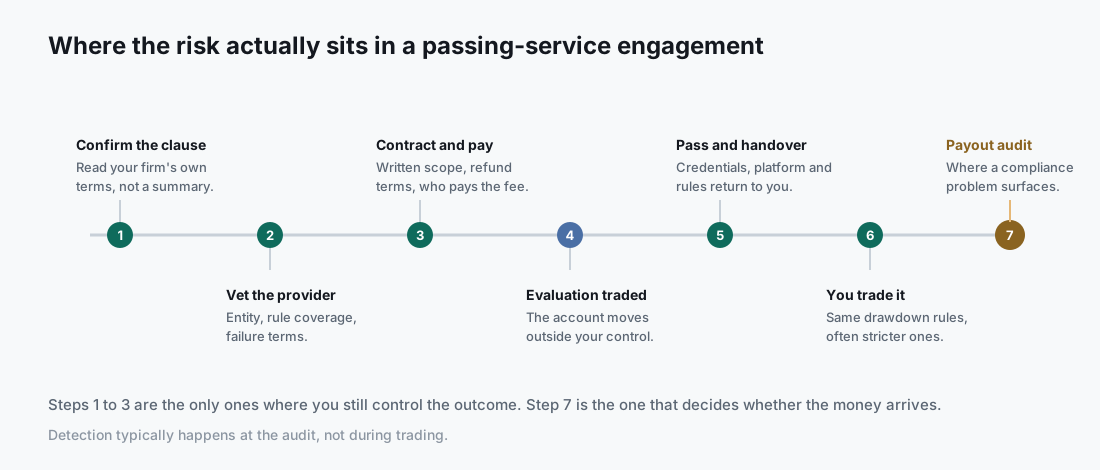
- Confirm the clause. You control this completely, and it is free.
- Vet the provider. You control this too, and it costs nothing but time.
- Contract and pay. The last point at which the decision is reversible cheaply.
- The evaluation is traded. Control passes to the provider. You can observe, not influence.
- Pass and handover. Credentials and rules return to you. This is where the second hard test begins.
- You trade the funded account. Same drawdown rules, often stricter payout conditions, and usually an activity requirement on top.
- The payout audit. Where compliance questions surface, and the only stage whose outcome you cannot fix locally.
Two practical consequences follow. Because your control collapses after step three, the diligence has to be done entirely within steps one and two — there is no later stage at which a problem can be corrected cheaply. And because the funded account is not a finish line but the start of a harder test, the honest question at step three is not "can this provider pass my challenge" but "can I keep what it hands me".
Contracts, tax and the paper trail
The unglamorous section is often the one that decides a dispute. Four things belong in a folder before any money moves:
- Your firm's terms, dated. The version in force on the day you pay, saved as a file rather than a bookmark. Terms change, and the applicable version is the one that mattered when the conduct occurred.
- The provider's written scope and failure terms. Signed or at least in writing, with the account size, the risk parameters and the refund or retry remedy stated explicitly.
- Payment records. A documented method that ties the payment to the agreement, not an irreversible transfer to an unverified address.
- The firm's written reply on third-party trading, if you have one, alongside the clause it may or may not match.
Tax treatment is a separate topic and depends on your jurisdiction and how the income is characterised, not on the platform it arrived through. The tax on prop firm payouts page covers why these receipts are usually not capital gains, which records to keep, and what to ask an accountant rather than a forum. Whether a service fee is deductible against trading income is a question for that accountant, and the answer differs by where you are.
The durable alternative
There is a version of this product that does not touch the third-party clause at all, and it deserves the space a ranking page usually gives to a sponsored slot: assisted trading. You place every order. The provider supplies the plan, the position sizing, the rules mapping and a review of your execution. No clause about who may trade the account is engaged, because you are the only one trading it.
It is slower, and it is not what most buyers are shopping for when they search for the best passing service. But it is the only version where the outcome compounds. A trader who passes with help and understands why each decision was made can pass the next challenge unaided, which makes the first fee an investment rather than a subscription. A trader who buys a funded account has purchased one account and will need to purchase the next one too.
If the reason you are looking at this product is that your own attempts keep ending the same way, the more direct fix is before the purchase rather than after it. The five-step method in how to pass a prop firm challenge and the sizing formula in prop firm risk management address the actual cause. If the reason is time, capital or access, a service is a legitimate answer, and the checklist above is how to choose one.
Frequently asked questions
What is the best prop firm passing service in 2026?
There is no single best provider, because the ranking depends on your firm's third-party trading clause before it depends on anything a provider does. Start there. If your firm permits it in writing, the best provider is the one that scores highest on the weighted comparison above, with rule coverage and failure terms carrying the most weight after compliance. If your firm prohibits it, no provider qualifies and the assisted model is the only permissible version of the product.
Can I pay someone to pass my prop firm challenge?
You can buy the service. Whether the resulting pass stands depends entirely on your firm's terms. Where third-party trading is prohibited, the evaluation can be voided and a payout withheld even after a successful pass, and the check usually happens at the payout review rather than during trading.
Is a passing service a scam?
Some are. The pattern is consistent: guaranteed passes, no verifiable legal entity, public complaints about withheld payouts or refused refunds, and no clear statement of how the firm's rules are handled. Others are real businesses selling a real outcome with defined terms. The 12-point checklist separates them, and it is worth more than any rating.
How much should a passing service cost in 2026?
Compare on cost per funded account rather than on the sticker fee. A fixed fee in the low four figures, with retries priced and no ongoing charges, is a materially different product from a low headline fee plus a monthly retainer. A single fixed fee can legitimately beat four self-traded attempts on cost; a retainer almost never does.
Will my prop firm find out that someone else traded my account?
Frequently, yes, and at the payout audit rather than in real time. Firms correlate payment details, IP addresses, devices and trading patterns, and a provider trading several clients produces the kind of cluster that linkage is designed to find. "Probably not caught" is a probability, not a permission.
What happens to the funded account after a bought pass?
You trade it under the same drawdown rules as the evaluation and often stricter payout conditions, plus any activity requirement. If the behaviour that failed your own attempts has not changed, the funded account is where it shows up next. This is the most common way a bought pass turns into a wasted fee.
Do passers get the challenge fee refunded?
At many firms the fee is returned on passing, or credited against the first payout, and the conditions matter more than the fact. Who actually pays the challenge fee — you or the provider — needs to be in the written scope, because it changes the refund outcome. See challenge costs and refunds.
Is buying a funded account ever the right decision?
Yes, in a narrow set of cases: your firm permits third-party trading in writing, the fee is money you can lose without touching risk capital, you have a specific plan for the funded account that differs from what failed before, and the provider is transparent about rule coverage and failure terms. Outside those conditions, the purchase is buying a repeat of the same outcome at a higher price.
How long does it take to pass with a service?
Providers typically quote a few days to a few weeks, constrained by the firm's minimum trading days and the size of the profit target. Speed is not a quality signal here. A provider that moves fast at a firm where the arrangement is prohibited has simply been fast at something that will not pay.
What should I do first, before paying anyone?
Read your firm's clause on third-party trading and save a dated copy. That single step disqualifies most of the market and costs nothing. Everything else on this page is a decision you only need to make if the clause comes back as a clear, written yes.
Bottom line
- The firm's clause outranks every other factor. Where third-party trading is prohibited, the pass can be voided and a payout withheld, whatever the provider promises.
- Automation and third-party trading are different rules. A provider quoting an EA policy is answering a question you did not ask.
- Compare cost per funded account, not the sticker fee. A fixed fee can beat four failed attempts; a monthly retainer almost never beats anything.
- Vet in the order given. Compliance, rule coverage, failure terms — then price. Undefined failure terms mean nothing in a dispute.
- A pass buys an account, not the discipline to keep it. Funded accounts enforce the same rules, and often stricter payout conditions.
- The assisted model is the only one that compounds. It engages no third-party clause and leaves the skill with the trader, which is the difference between a purchase and an investment.
If you are going to compare providers at all, do it from your firm's terms outward. Read the clause, save it, keep the provider's written scope, and price the whole route rather than the first step. The prop firm FAQ answers the related rules questions, and the honest assessment of passing services covers the parts of this decision that are not about money.
Two companion pages go deeper on the parts of this that are easy to get wrong. The category review explains what a review of this market can actually verify and what it cannot. And the pricing breakdown works through all four fee models, because the model changes the total far more than the headline number does.